Using an
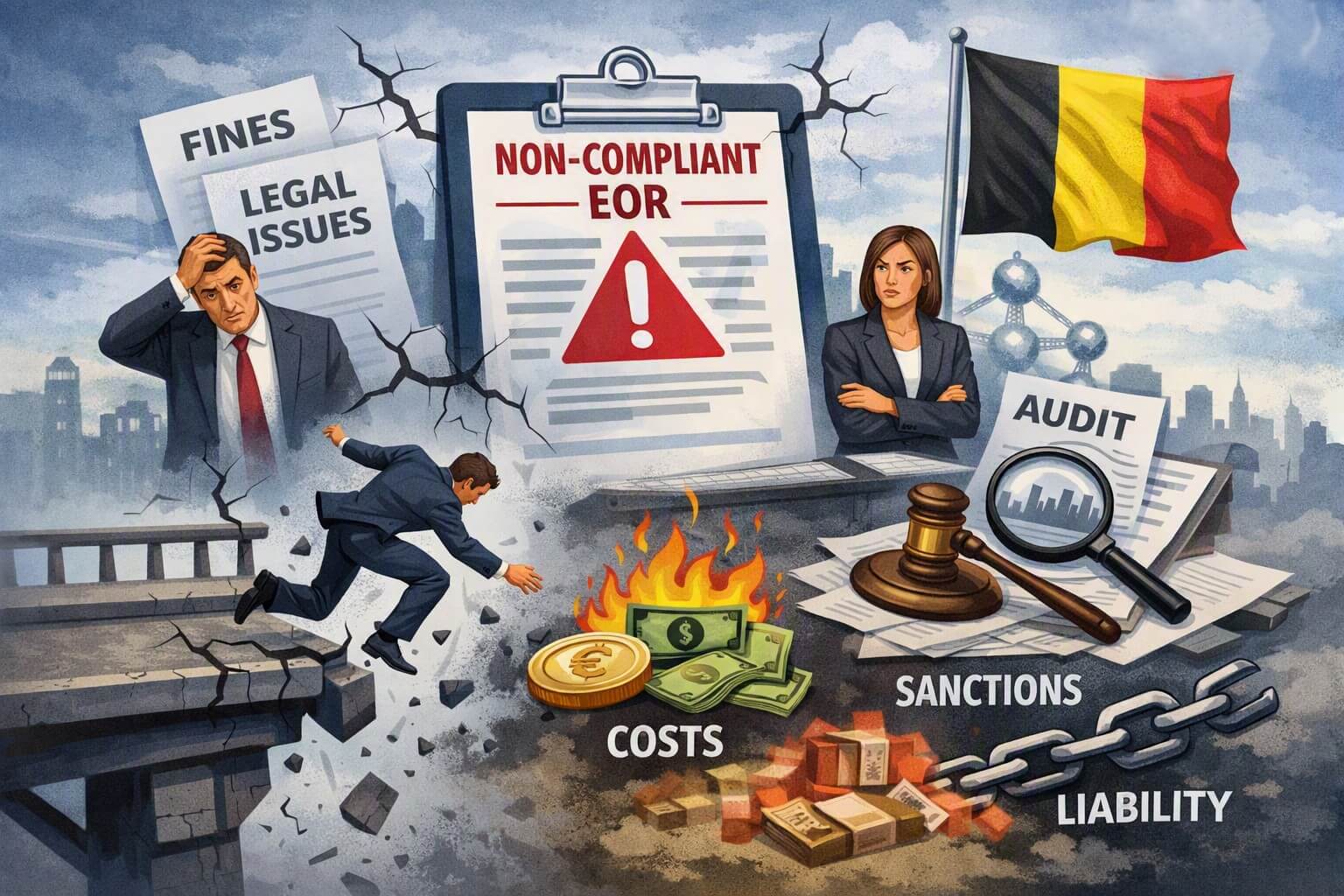
EOR that does not meet the applicable Belgian requirements can create risks for both the EOR and the client company. Keep in mind there are a lot of unlicensed EOR agencies in Belgium.
Important: This article provides general information and is not a substitute for legal advice on a specific employment structure.
Risk of unlawful employee lending
If the client company exercises employer authority without the arrangement falling within a legal exception, the structure may be considered prohibited employee lending as specified under the Belgian Act of 24 July 1987.
Employment status and contractual risk
A worker may challenge the structure if the contractual employer does not reflect the actual employment relationship. Questions may arise about:
- Who is responsible for employment decisions
- Which company must comply with Belgian employment rules
- Who is liable for salary and benefits
- Which company is responsible for dismissal decisions
- Whether the employment contract accurately reflects the work arrangement
- What is the duration of the employment contract
Payroll and social security exposure
A non-compliant structure may create questions about payroll withholding, social security registration and employer reporting. Errors can lead to additional administration, corrections and potential liability.
Belgian temporary agency workers are also entitled to the same pay they would have received if they had been hired directly by the user company for the same role, subject to the applicable rules.
Joint liability and financial exposure
In certain forms of unlawful employee lending, the parties may face liability relating to remuneration, benefits and social security contributions. The Federal Public Service Employment also warns that employers who unlawfully hire out workers may face criminal prosecution or administrative fines.
Immigration and work permit complications
For non-European employees, the employment structure may also affect work authorisation and residence arrangements.
The company named in the employment and immigration documents must be consistent with the actual employment situation. An EOR structure that does not properly reflect the Belgian requirements could complicate work permit, single permit or residence-related processes.
Immigration, payroll and employment compliance should therefore be assessed together rather than as separate administrative tasks.
Why a fast EOR solution may not be the safest option

International companies often turn to an EOR because they want to:
- Hire quickly
- Avoid setting up a local entity
- Test the Belgian market
- Employ one or a small number of people
- Centralise international payroll
- Reduce the administrative burden on internal HR teams
These are valid commercial objectives. However, speed should not replace a legal and operational assessment.
A provider may offer to hire an employee in Belgium within a few days, but that does not necessarily confirm that the arrangement is compliant with Belgian rules. Before signing, the client should understand:
- Which legal entity will employ the worker
- Where that entity is established
- Whether it holds the required regional recognition or licence
- Whether the worker is being made available to the client
- Who exercises employer authority
- Which company handles payroll and social security
- How termination decisions are managed
- Whether the arrangement is intended to be temporary
- How work permits and immigration responsibilities are allocated
A lower-cost or faster solution can create greater cost and uncertainty if the underlying structure is not compliant.
EOR or Belgian payroll outsourcing?

An EOR is not the only way for an international company to employ people in Belgium.
Depending on the circumstances, a company may instead:
- Establish a Belgian legal entity
- Register as a foreign employer
- Employ workers directly and outsource payroll administration
- Work with a Belgian payroll and HR partner
- Use an authorised temporary employment agency where the arrangement genuinely falls within temporary agency work
- Combine Belgian payroll support with international payroll coordination
With payroll outsourcing, the client remains the employer and the payroll provider supports administrative processing and compliance. With an EOR, the third party becomes the formal employer, while the client usually directs the employee’s day-to-day work.
The right structure depends on factors such as:
- The number of employees in Belgium
- Whether the company already has a Belgian entity
- The expected duration of the employment
- The employee’s nationality and immigration status
- The role and working arrangements
- Where the employee will work
- Which company will exercise employer authority
- The company’s longer-term plans for Belgium
A practical compliance checklist for international employers
Before choosing an EOR in Belgium, ask the provider for clear answers to the following questions.
Is the provider licensed or recognised where the employee will work?
Do not accept a general statement that the provider is “compliant in Belgium”. Ask for the relevant licence or recognition details and confirm which Region or Community they cover.
Who is the legal employer?
Identify the precise legal entity that will sign the employment contract, process payroll and assume employer responsibilities.
Is the arrangement temporary agency work?
Ask how the provider legally classifies the arrangement and whether the employee is being made available to the client company.
Who exercises employer authority?
Clarify who is responsible for:
- Hiring
- Daily instructions
- Working time
- Leave approval
- Performance management
- Disciplinary action
- Salary reviews
- Termination
How are regional rules addressed?
The applicable process may differ depending on whether the employee works in Flanders, Wallonia, Brussels or the German-speaking Community.
How are payroll and social security obligations managed?
Confirm how the provider handles Belgian payroll registration, social security, tax withholding, payroll reporting and employee documentation.
How are immigration requirements coordinated?
For non-European employees, clarify which party manages work permits, single permits, residence documentation and communications with the relevant authorities.
What happens if the arrangement is challenged?
The contract should explain responsibility, cooperation, documentation and costs if an authority questions the structure.
Who can support you with a compliant Belgian payroll setup
International companies entering Belgium need more than a payroll calculation. They need a structure that connects employment administration, payroll, tax, social security and, where relevant, immigration requirements.
Although there are many payroll providers in Belgium, we see that very few can support foreign employers with:
- Belgian payroll setup
- Employer registration and administration
- Payroll processing
- Belgian payroll and employment compliance
- Socio-legal and HR guidance
- Tax and compliance support
- International payroll coordination
- Immigration support for work permits, visas and residence applications
- Assessment of the practical responsibilities connected to a Belgian employment model
Where an EOR structure requires temporary employment agency recognition or licensing, only a few specialized payroll providers assist companies in assessing the requirements and preparing the relevant setup. The appropriate solution will depend on the facts of the arrangement, the employee’s work location and the division of authority between the parties. We have identified a few suitable parties on the Belgian market that we trust in.
Conclusion: avoid using an unlicensed EOR
The most important is to check the legal structure before choosing the provider. An EOR can be useful for international companies hiring in Belgium, but it should not be treated as a simple administrative shortcut.
BusinessBelgium is supporting the readers of this article. We assists foreign employers who want to hire talent in Belgium while fully complying with Belgian legislation, analysing the most suitable employment setup for their situation and guiding them through every step of the process. It also helps EOR providers seeking a Belgian licence by connecting them with a trusted partner who can support their application smoothly and reliably.
If you’re ready to move forward, simply complete the form below and contact us.
Liked What You Read? Share This Article: